
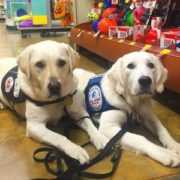
Labrador retriever service dogs

Service Dogs

Not long ago, I was in our local bakery when a woman walked in with her dog. It was a small breed dog. As soon as they walked through the door, the dog was pulling in all directions. Sniffing around, trying to snatch any little crumbs on the floor. Even jumping up on the display case. An employee walked over and asked the woman if it was a service dog (Side note, there is only one question a business can ask a person regarding service dogs: 1. Is this a service dog? While a person may carry some sort of certification of training it is not required.) The woman answered yes, but I noticed that after a few seconds she told her friend, who she was with, to go a ahead and order and she would wait outside.

Is it just me or has anyone else noticed an increase in “service dogs” out and about? I put the phrase service dogs in quotes because there is no way these dogs can be performing a service to their owners with the behavior they are exhibiting.

A service dog is a dog that is highly trained to perform tasks that an individual can’t do for themselves. Training can take up to 2 years. Think of a dog helping a blind person cross the street or alerting a deaf owner to the doorbell ringing or bracing someone when they have a seizure or picking up and retrieving things for someone with impaired mobility. Not only do service dogs need to be able to learn complex tasks, but they need to have a temperament that allows them to be able to stay focused in a public setting. Flash back to the dog in the bakery, pulling as hard as it possibly could to try and reach some morsel of food on the ground. If that was a service dog, it was the most poorly trained service dog I’ve ever seen.

You may be thinking, ok, but why does it matter? So people love their dogs and want to be able to bring them everywhere with them. What’s the harm? Well the harm is to the people who actually need service dogs and to the agencies that train them. The law is deliberately set up so there is no burden of proof on people with disabilities who benefit from service dogs, but if the law gets abused then maybe that could change. People who spend their time training these dogs can get a bad reputation and their efforts can be hurt when people pass off misbehaving dogs as service dogs.

So, love your dog. Train your dog so they can go with you to any businesses that allow them, but don’t try to pass them off as something that they are not.  And if you want help with that training just contact us!
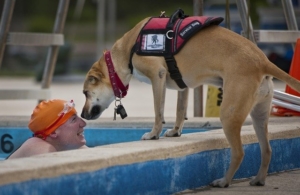
Service dog

image by Skeeze from Pixabay


To learn more about service dogs vs support or therapy dogs check out this link:

To learn about the American Disabilities Act and  a Minnesota bill that is being considered to fine those passing off pets as service dogs go here:

https://www.mprnews.org/story/2018/03/07/mn-bill-would-fine-owners-passing-untrained-pets-as-service-animals

Learn More: puppy training asheville

Chihuahua sitting on pillow

Meet Our New Rescue Dog, Satellite!

If you’ve worked with Todd, then you know he loves German Shepherds. You may even have met one of ours at a lesson, but what you may not know is that we have fostered and rescued a lot of dogs over the years. I won’t share the exact number because then you may think we’re dog hoarders. Actually, it would just take me too long to count.

It has been awhile since we’ve added a new rescue dog to our pack, but with our pack dwindling to a mere 5 and the loss of our chi-chi, Potato, this summer; it seemed time.

What? You think my ears are big?

A few weeks ago we adopted Satellite. A 3 year old or so Chihuahua who ended up at the shelter when her home was condemned. Ever since she has been living with us we have been reminded of what it is like to bring a rescue dog into your home.

So, some tips to keep in mind if you find yourself stalking rescue group websites  and ogling over those cute furry faces:

What you see isn’t necessarily what you get. Dogs in shelters are traumatized and are likely not acting as they would in a normal house situation. They are stressed which can make them milder or wilder than they really are.

They have a history, you just don’t know it. Shelter workers do their best to assess dogs that come in to them, but often background info is scant and they have limited resources and time to perform assessments. For instance, how can they say if a dog is good with kids if they don’t know if it has ever been around a child?

Be patient and be vigilant. It will take time for everyone to adjust to the new situation, especially if you already have animals at home. You will have to figure things out as you go. The most important thing is that as soon as your new rescue dog comes home with you, you help guide it so it can learn the ropes of your house.

It is a lot of work at the beginning, but it will be so worth it.

Just in case you’re looking:

Asheville Humane Society

Brother Wolf Animal Rescue

Learn More: dog trainer asheville

Balanced Dog Training

Here at the Asheville Dog Company we believe in a balanced approach to dog training.  I tell people this a lot and have noticed that many nod their head and smile but it occurred to me that a good number of those people probably have no idea what I am talking about.  So here goes…

Balanced dog training, in simple terms, means that we assess the overall picture of dog and owner and try to use a variety methods to ensure us the best chance of getting lasting results.  Trainers started using this term several years ago partly in response to the “All-Positive” training fad that was emerging and gaining strength.  This group of All-Positive trainers claim that you can achieve the same level of success in training by only using positive reinforcement (treats, praise, and toys in exchange for behavior).  True or not, the problem with using this approach to training eliminates half of the experiences ALL animals learn from.

You see, learning in all animals works the same up to a point.  Operant Conditioning is how animals learn from interactions with their environment.  In simple terms, if we do a behavior and it leads to a positive outcome, we as animals are more likely to do this behavior in the future.  I totally agree with this statement and it is the foundation of how we train behavior at the Asheville Dog Company.  However, I also understand that this is only half the picture.  You see, if a behavior consistently leads to a negative experience this same science tells us that this behavior will happen less often.  To ignore this fact is ignoring the science of how animals learn.

Balanced dog trainers understand that although the foundation to good training is through the use of reward, we also acknowledge that consistency and harmony in training can only be reached when a dog understands not only what behaviors are good and worthy of reward but also understand that certain behaviors are off-limits and can have consequences.  Through this process we raise a well-rounded member of the canine community; dogs that are happy while having a healthy respect for leadership.  We are helping owners to raise dogs that understand how to deal with negative experiences, persevere and come out the other side stronger and smarter.  After all, isn’t that what life truly is all about.  Mistakes are a crucial part of the learning experience, but this only holds true if these mistakes lead us to future success.  Take, for example, the student who acts out in class.  If the teacher ignores this behavior, because if not reinforced it should go away, but students in class giggle and snicker, the teacher will find the behavior does not go away.  If, as a dog trainer, I try to merely ignore unwanted behavior, then I don’t give the dog a clear message, I will get mixed results.  You must understand what is motivating behavior in order to correctly address it. It can certainly seem confusing and overwhelming at times to know what to do but one thing for me seems clear….leaving half of my tools at home because the word punishment doesn’t sound nice is not in my client’s or the dog’s best interest. There is no one right way to train a dog but there can be ways that are faster, smarter, and more effective.